News Release (Correspondents: Han Peng, Huang Yuanxin) On the morning of April 28, Professor Zhu Jun from the School of Science and Engineering, the Chinese University of Hong Kong, Shenzhen, was invited to deliver an academic lecture at the 25th Postgraduate Innovation Academic Forum of our university. The lecture was presided over by Professor Yu Xianglin, Vice Dean of the School of Chemical Engineering and Pharmacy.
Entitled Never Stop Exploring the World: Diving, Hiking and Aromaticity, Professor Zhu Jun shared his unique experience of integrating exploration into daily life and scientific research. Combining his personal experiences in diving, hiking and skiing, he illustrated how to strike a balance between personal passion and academic work. Driven by strong curiosity and persistent dedication, he has long been engaged in organometallic chemistry and aromaticity research, and proposed the concept of adaptive aromaticity, which suggests that compounds can exhibit aromaticity in both singlet and triplet states.He also elaborated on exploring aromaticity and nitrogen activation by combining density functional theory calculation, machine learning and chemical synthesis.
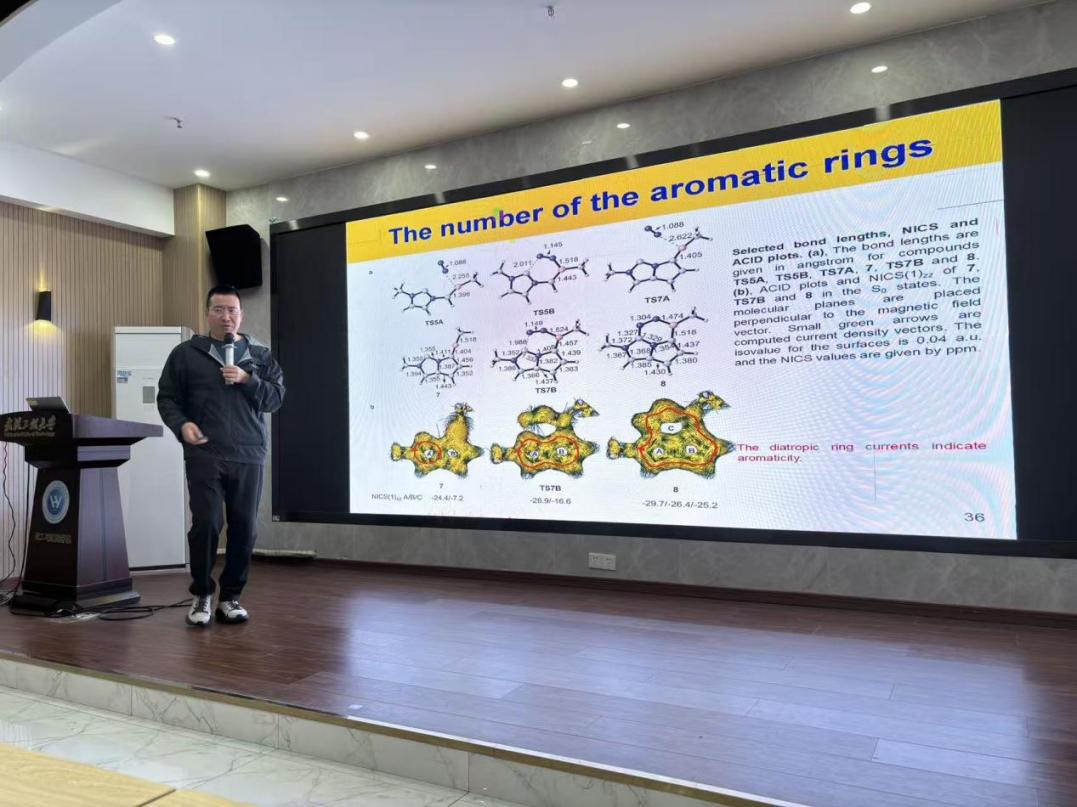
Professor Zhu Jun had in-depth discussions with teachers and students present on the concept of adaptive aromaticity and the application of machine learning in chemical research. He patiently answered puzzles encountered by faculty and students in scientific research practice, offering valuable insights and research directions for relevant fields.
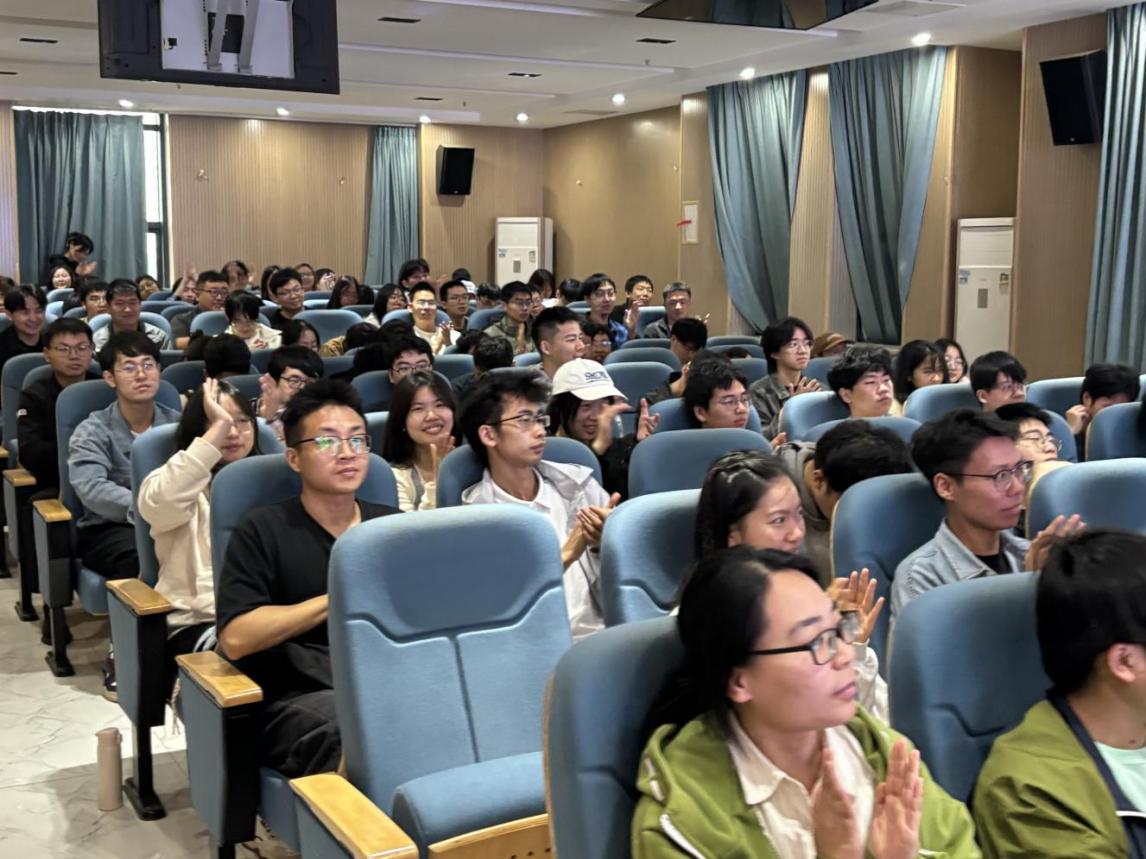
Professor Zhu Jun delivered a cutting-edge and fascinating lecture. The lecture hall was fully under a warm and lively atmosphere. More than 150 teachers and students from relevant schools attended the academic event.(Reviewed by Yu, Xianglin, Yang, Haibo)
Speaker Profile
Zhu Jun is a Professor and Presidential Scholar at the School of Science and Engineering, The Chinese University of Hong Kong, Shenzhen. He is also a marathon and triathlon athlete, a Master Scuba Diver, and an avid skiing enthusiast, who integrates the spirit of exploration into both daily life and scientific research. He was awarded the National Young Talents in 2014 and the National Science and Technology Innovation Talents in 2023. He has presided over 7 projects funded by the National Natural Science Foundation of China, including 1 Key Program. He has published over 249 SCI papers in journals such as Nature Chemistry (1), Nature Synthesis (1), Nature Communications (5), Angewandte Chemie International Edition (20), and Journal of the American Chemical Society (17). He has won the Second Prize of the National Natural Science Award (ranking third). His research focuses on organometallic chemistry. He has been engaged in research on molecular structure, chemical bonding (aromaticity) and chemical reactivity (nitrogen activation) by means of quantum chemical calculation and machine learning,in a long period of time. He proposed the concept of adaptive aromaticity beyond the classic Hückel rule and Baird rule, advancing aromatic chemistry from the era of singlet-state aromaticity to two-state aromaticity. Meanwhile, he has explored the application of this concept in singlet fission materials.