Faculty and Students from the School of Chemical Engineering and Pharmacy Publish Important Research Findings in
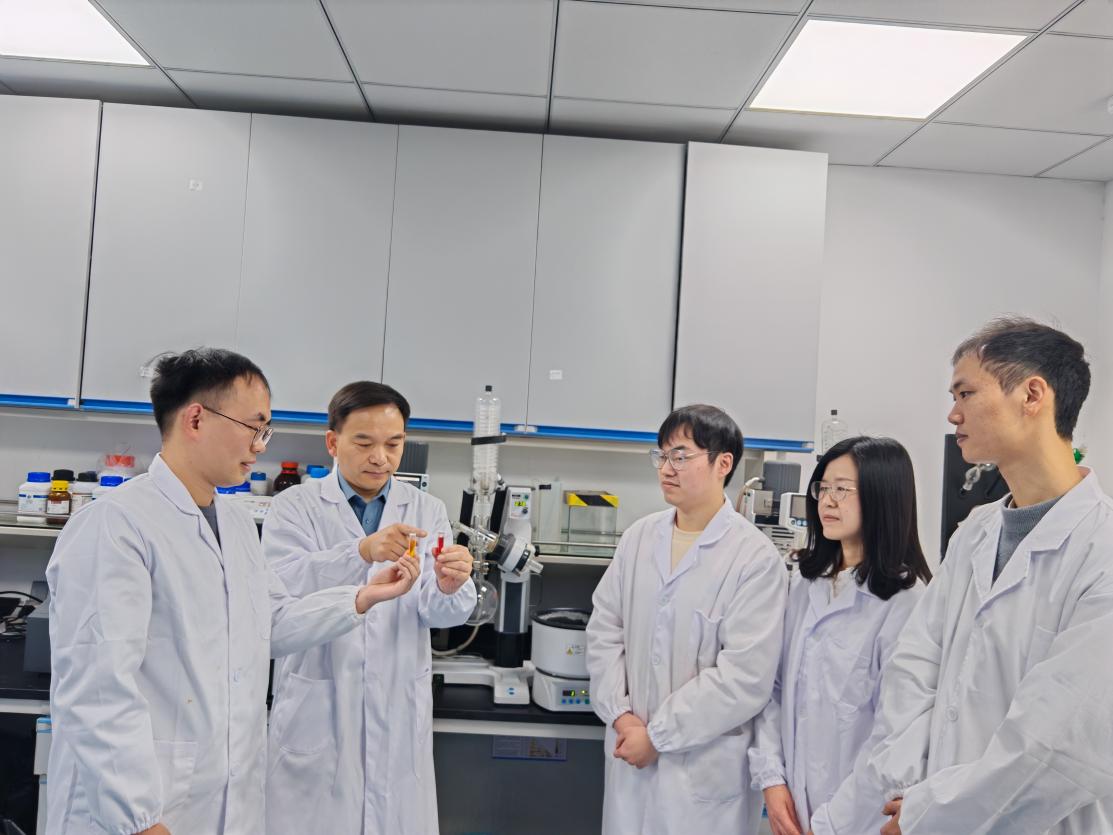
News Release (Correspondents: Yang Gongming, Long Jiao) Recently, a research team led by Professor Gu Shuangxi from the School of Chemical Engineering and Pharmacy published a research paper titled “Rapid Enantioselective Fluorescence Recognition and Chiral Separation of Free Amino Acids” in the internationally renowned journal Nature Communications. Wuhan Institute of Technology is listed as the first affiliation. Associate Professor Li Yang from the School of Chemical Engineering and Pharmacy, Yu Kang (Master’s graduate of the Class of 2024), and Xu Zhiyong (PhD candidate enrolled in 2023) are the co-first authors of the paper. Professor Zhu Yuanyuan from the School of Chemistry and Environmental Engineering, Professor Gu Shuangxi from the School of Chemical Engineering and Pharmacy, and Professor Ma Xiang from East China University of Science and Technology are the co-corresponding authors.
Chirality is one of the fundamental properties of nature. Biomolecules that underpin all life processes, such as amino acids, sugars, proteins and enzymes, are chiral. Numerous biochemical reactions occurring in living systems are closely associated with chiral recognition. Due to the intrinsic chiral environment within organisms, chiral drugs with different configurations often exhibit markedly different pharmacological activities and toxicities. Chiral drugs make up a substantial proportion of marketed pharmaceuticals, blockbuster drugs and drug candidates in development. For this reason, the analysis and separation of chiral compounds have attracted widespread attention from both academia and industry.
Enantioselective recognition and chiral separation of free amino acids are of vital importance in numerous fields including life science, food science, chemical industry and pharmaceutical analysis. Although conventional chiral separation techniques such as chiral chromatography have been established, they generally involve cumbersome analytical procedures and are incapable of real-time or in-situ detection. Featuring high sensitivity, rapid response and simple operation, fluorescence sensing technology offers a promising alternative for chiral recognition. Nevertheless, developing fluorescent probes that can simultaneously achieve rapid enantioselective recognition and chiral separation of free amino acids in water remains highly challenging.
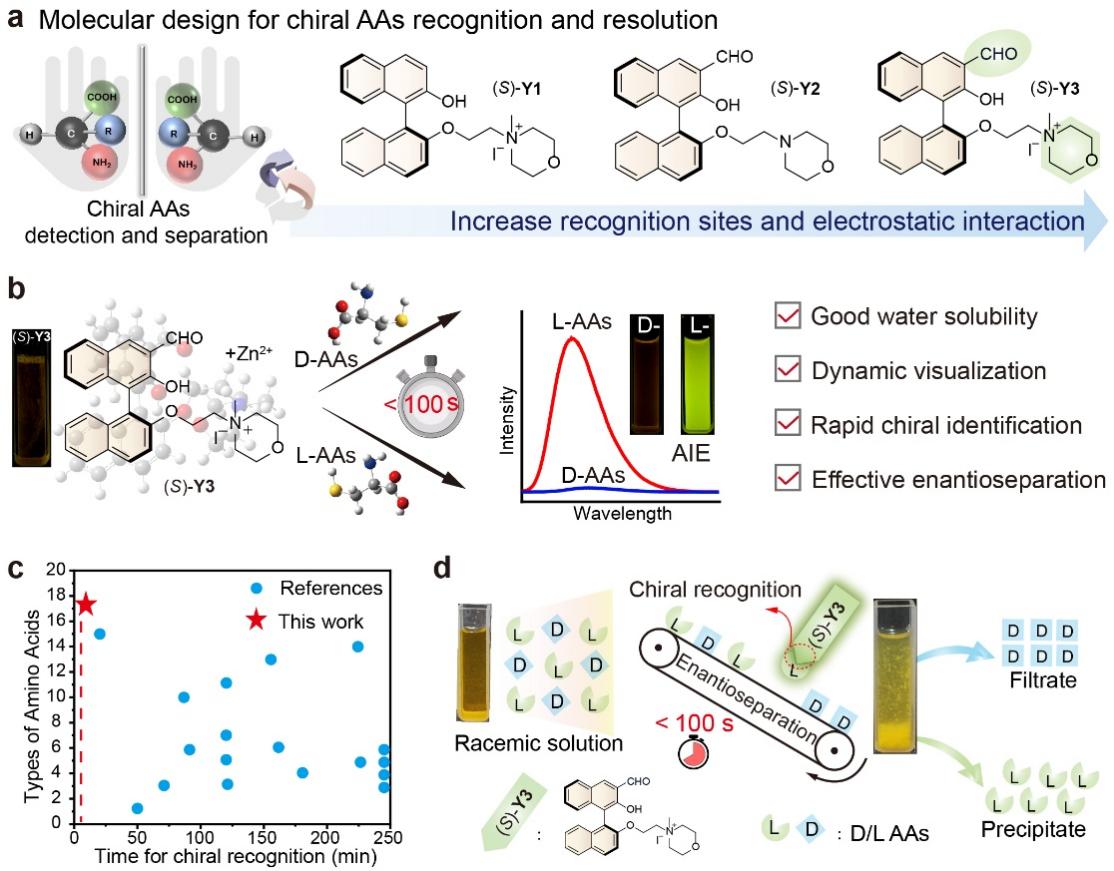
To address these challenges, the research team incorporated morpholinium quaternary ammonium cations into the molecular scaffold of 1,1'-bi-2-naphthol (BINOL), thereby rationally designing and synthesizing a chiral fluorescent probe. This probe achieves rapid chiral recognition of amino acid enantiomers in aqueous solution, as well as efficient minute-scale chiral separation of single amino acid enantiomers from racemic mixtures. Upon interaction with 17 pairs of free amino acid enantiomers, the probe realizes rapid chiral discrimination within 100 seconds, accompanied by prominent changes in luminescence color or intensity. Mechanistic investigations reveal that the chiral recognition process involves imine formation, electrostatic interactions, and the aggregation-induced emission (AIE) effect. These synergistic processes promote selective aggregation and precipitation between the probe and specific amino acid enantiomers. Adopting the methodology developed by Professor Gu Shuangxi’s team, target enantiomers can be efficiently separated from D-/L-amino acid mixtures via simple filtration, delivering optical purity exceeding 99% with visible separation procedures. The team further validated the superior chiral separation performance of this probe by comparative analysis combining fluorescence visualization and chiral high-performance liquid chromatography (chiral HPLC). Aligned with the national strategy for life and health, this research underpins the development of Hubei’s biomedical industry. It offers a simple, rapid new strategy for accurate detection and separation of amino acid enantiomers, with profound scientific significance and great practical application value.
Nature Communications is a top international multidisciplinary journal published by Nature Portfolio. It is dedicated to publishing high-quality research findings across biology, chemistry, physics, materials science, earth and environmental sciences, medicine, engineering and other disciplines, with its latest impact factor of 15.7. This journal is included in the Catalogue of Major Landmark Achievements for the University’s First-Class Disciplines.
In recent years, the university has adopted a multi-pronged approach to accelerate the development of first-class disciplines. By rolling out a comprehensive set of supporting measures, including the implementation of the "Jiebang Guashuai" (open competition for key research tasks) system for major landmark achievements in first-class disciplines, the issuance of corresponding incentive policies, and the formulation of classified grading lists for research achievements and academic journal rankings, the university has effectively boosted the output of high-level research achievements.
(Reviewers: Xiong Lun, Jiang Xueliang, Yang Haibo, Zhang Zongliang)
Original Article Link: https://www.nature.com/articles/s41467-025-68144-y