Research Achievements by Undergraduate Student from the School of Chemical Engineering and Pharmacy Published in ACS
Catalysis
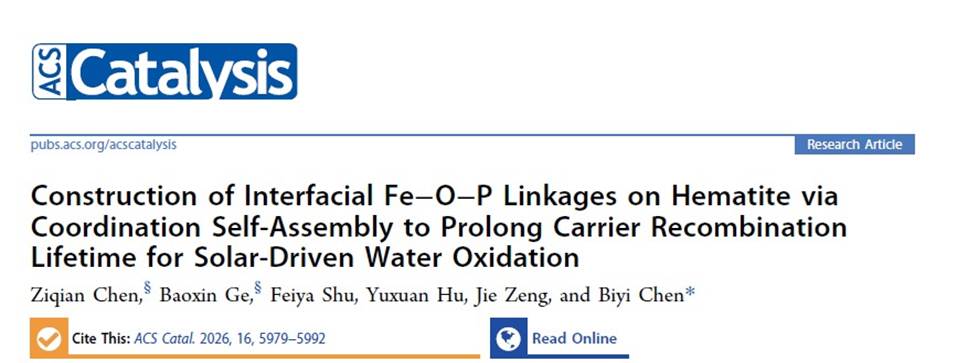
News Release (Correspondents: Tang Xi, Chen Biyi) Recently, Chen Ziqian, a 2022 undergraduate majoring in Chemical Engineering and Technology (Sino-Foreign Joint Program) at the School of Chemical Engineering and Pharmacy, has published a research paper as the first author in ACS Catalysis, a well-known top journal in the international catalysis field (Q1 Top Journal, Impact Factor = 13.1). The paper is titled Construction of Interfacial Fe-O-P Linkages on Hematite via Coordination Self-Assembly to Prolong Carrier Recombination Lifetime for Solar-Driven Water Oxidation.
Article Link: https://pubs.acs.org/doi/full/10.1021/acscatal.6c00210
Hematite (α-Fe₂O₃) has become a major research focus for semiconductor photoanodes thanks to its high earth abundance, a moderate band gap of ~2.1 eV, and an excellent theoretical photocurrent density of ~12.6 mA cm⁻⟡. Nevertheless, high-density surface defect states on hematite trigger severe interfacial charge recombination, resulting in actual photocurrent densities and onset potentials far inferior to theoretical predictions. While conventional surface passivation strategies can curb surface charge recombination, their performance gains are severely limited by multiple drawbacks: high interfacial charge transfer barriers, charge trapping and recombination inside thick, high-resistance overlay films, and inadequate catalytic activity toward the oxygen evolution reaction (OER). Balancing efficient surface passivation with fast extraction and transport of charge carriers remains a core challenge for photoelectrode interface engineering. To address this critical bottleneck, this work proposes an innovative interfacial coordination self-assembly strategy to fabricate an ultrathin (~2 nm) amorphous phytate–iron–nickel (PA–FeNi) composite layer on Fe₂O₃, which precisely constructs atomic-scale Fe–O–P bond linkages at the interface. This architecture effectively saturates surface dangling bonds to mitigate charge recombination losses and establishes high-speed charge transfer pathways, drastically extending the lifetime of photogenerated holes from 1.5 ps to 297.7 ps. Benefiting from these synergistic effects, the optimized photoanode delivers a remarkable photocurrent density of 3.29 mA cm⁻⟡ at 1.23 V_RHE, representing a 3.05-fold enhancement relative to pristine Fe₂O₃ with a 170 mV negative shift in onset potential. Moreover, the electrode retains an ultrahigh stability of 99.3% over a 24 h continuous illumination test.
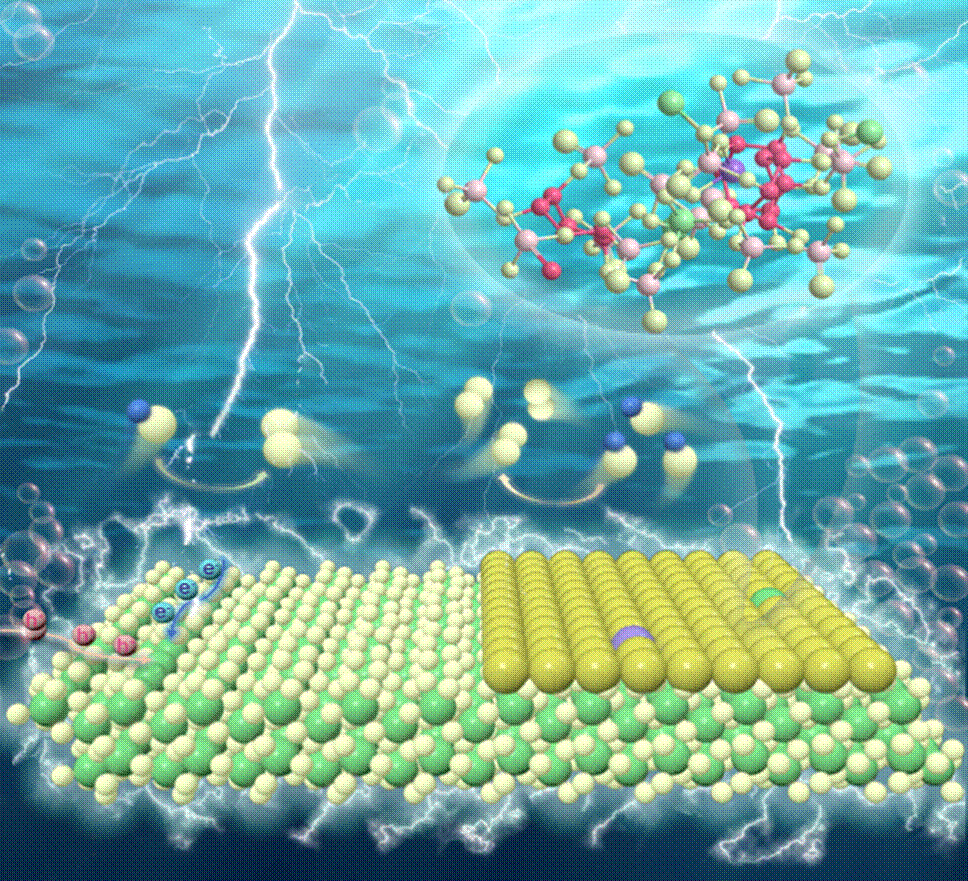
Chen Ziqian joined the research lab for academic training during her freshman year. Under the dedicated guidance of Professor Chen Biyi, she embarked on research in photoelectrocatalytic energy conversion. After systematic training in experimental skills, she took charge of a national innovation and entrepreneurship training program for college students as the project leader. Her preliminary research outcomes were published in Inorganic Chemistry Frontiers (2024, 11, 5111), a Q1 Top Journal with an impact factor of 7.0. Phytic acid (PA) features a unique hexaphosphoinositol skeleton and abundant phosphate groups, which endow it with strong multidentate coordination, self-assembly and superhydrophilic properties. These characteristics inspired her to conduct in-depth research on the inherent restriction mechanisms of interfacial charge transport and surface passivation on photoelectrodes. In the subsequent years, under the guidance of her supervisor, Chen Ziqian independently completed project design, material characterization and photoelectrochemical performance measurements.This study verifies that the introduction of a PA-FeNi layer on hematite photoanodes can precisely passivate surface defects and simultaneously construct high-speed charge transport pathways via an in-situ formed metal-organic network, breaking the inherent bottleneck of traditional passivation layers that cannot balance passivation efficiency and charge transport performance. Furthermore, this strategy has been extended to multiple systems, proving that the PA-metal complex modification method exhibits outstanding universality for mainstream metal oxide photoelectrodes including WO₃, BiVO₄ and TiO₂.The entire research route, from raw material selection to synthetic procedures, is green and low-consumption, consistent with the concept of sustainable development. This work provides a green, facile and universal new paradigm for interfacial optimization of high-efficiency photoelectrodes.
Since joining the lab as a freshman, Chen Ziqian has yielded remarkable research outputs: she has published two SCI articles as the first author with a combined impact factor above 20, plus one co-authored SCI paper. She has claimed 2 national and 3 provincial competition honors, including the National College Student Life Science Competition (Innovation & Entrepreneurship Track), the "Challenge Cup" National Competition for Extracurricular Academic Science and Technology Works, the "Challenge Cup" China College Student Entrepreneurship Plan Competition, and the International University Student Innovation Program. Moreover, she has received numerous university-level honors, such as the First-Class Comprehensive Scholarship, Model Merit Student, Merit Student, Advanced Individual, Excellent Student Leader, Excellent League Cadre, and Outstanding Volunteer.
Wuhan Institute of Technology is the sole corresponding institution of this paper. Dr. Chen Biyi, a young faculty member from the School of Chemical Engineering and Pharmacy, acts as the corresponding author. This research was supported by the National Innovation and Entrepreneurship Training Program for College Students of Wuhan Institute of Technology (Grant No. 202410490003).
(Reviewers: Gu Shuangxi, Yang Haibo)